

Health - Today
Cortical thickness, schizophrenia, and causality in psychiatry: when the trace is mistaken for the cause
Cortical thickness, schizophrenia, and causality in psychiatry: when the trace is mistaken for the cause

Environment - Today
UCalgary expedition, with NASA, Canadian and European space agencies, sets out to better understand state of Arctic ice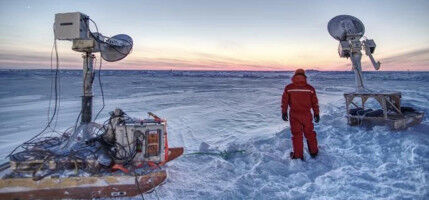
UCalgary expedition, with NASA, Canadian and European space agencies, sets out to better understand state of Arctic ice
Social Sciences - Mar 24
Young people's wellbeing is improving in Greater Manchester, major survey finds
Young people's wellbeing is improving in Greater Manchester, major survey finds

Environment - Mar 24
Australia's environment is improving but climate change is 'accelerating' damage to ecosystems and wildlife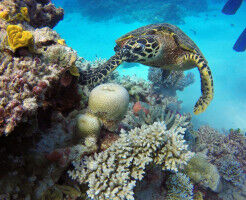
Australia's environment is improving but climate change is 'accelerating' damage to ecosystems and wildlife

Psychology - Mar 23
The grief myth: it doesn't come in stages or follow a checklist - like love, it endures
The grief myth: it doesn't come in stages or follow a checklist - like love, it endures

History & Archeology - Mar 23
The UV has played a part in the discovery of a 3,500-year-old loom that sheds light on key aspects of the Bronze Age textile revolution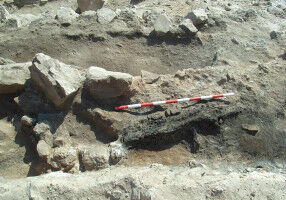
The UV has played a part in the discovery of a 3,500-year-old loom that sheds light on key aspects of the Bronze Age textile revolution
Innovation - Mar 23
The University of Valencia launches ClioViz, an open digital platform for accessing cultural heritage data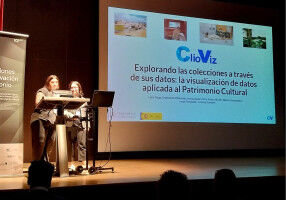
The University of Valencia launches ClioViz, an open digital platform for accessing cultural heritage data

Social Sciences - Mar 23
Study links higher concentration of pokie machines to increase in family and domestic violence
Study links higher concentration of pokie machines to increase in family and domestic violence
news
Centre national de la recherche scientifique (CNRS)
Results 381 - 400 of 477.
Life Sciences - 07.04.2017
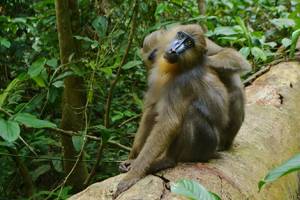
Researchers from the CNRS have discovered that mandrills use their sense of smell to avoid contamination by intestinal protozoans through contact with infected members of their group. Their work, published in Science Advances on 7 april 2017, shows that parasites shape the social behavior of these primates, leading them to develop a strategy of parasite avoidance through smell.
Life Sciences - Physics - 03.04.2017
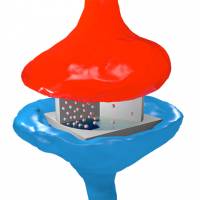
Researchers from the CNRS, Thales, and the Universities of Bordeaux, Paris-Sud, and Evry have created an artificial synapse capable of learning autonomously. They were also able to model the device, which is essential for developing more complex circuits. The research was published on 3 April 2017. One of the goals of biomimetics is to take inspiration from the functioning of the brain in order to design increasingly intelligent machines.
Health - Physics - 30.03.2017
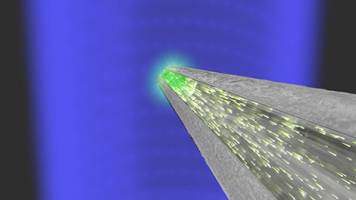
The ability to detect X-rays on a tiny scale paves the way for high-precision medical imaging and therapies. Such detection capabilities have been achieved by researchers from the CNRS, the University of Franche-Comté (UFC), and Aix-Marseille University (AMU), who attached an X-ray sensor to the end of an optical fiber.
Life Sciences - 21.03.2017
Gender discrimination: science is no exception
Gender discrimination can be found in the most unexpected fields. An international team, involving Demian Battaglia, a CNRS researcher at the Institut de neurosciences des systèmes, as well as researchers from Yale and the Max Planck Institute (Germany), has just demonstrated that women are underrepresented in the peer review of scientific publications.
Mechanical Engineering - Chemistry - 20.03.2017

Rewarded with a Nobel Prize in Chemistry in 2016, nanomachines provide mechanical work on the smallest of scales.
Health - Life Sciences - 15.03.2017

French researchers have identified a marker that makes it possible to differentiate “dormant” HIV-infected cells from healthy cells. This discovery will make it possible to isolate and analyze reservoir cells which, by silently hosting the virus, are responsible for its persistence even among patients receiving antiviral treatment, whose viral load is undetectable.
Life Sciences - 24.02.2017
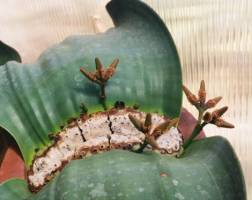
The mystery that is the origin of flowering plants has been partially solved thanks to a team from the Laboratoire de Physiologie Cellulaire et Végétale (CNRS/Inra/CEA/Université Grenoble Alpes), in
Astronomy & Space - Earth Sciences - 22.02.2017

Seven temperate Earth-sized planets revolve around the star TRAPPIST-1. In addition, at least three of them harbor conditions compatible with the presence of liquid water on their surfaces.
Astronomy & Space - 22.02.2017
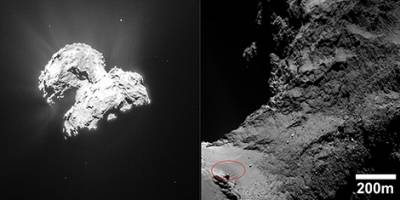
Surprising images from the Rosetta spacecraft show the presence of dune-like patterns on the surface of comet Chury. Researchers at the Laboratoire de Physique et Mécanique des Milieux Hétérogènes (CNRS/ESPCI Paris/UPMC/Université Paris Diderot) studied the available images and modeled the outgassing of vapor to try to explain the phenomenon.
Environment - 15.02.2017
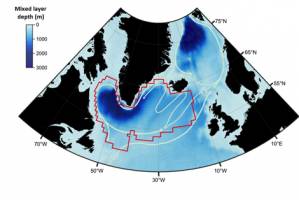
The possibility of major climate change in the Atlantic region has long been recognized and has even been the subject of a Hollywood movie: The Day After Tomorrow .
Life Sciences - 19.01.2017
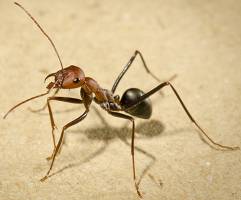
An international team including researchers at the university of Edinburgh and Antoine Wystrach of the Research Centre on Animal Cognition (CNRS/Université Toulouse III—Paul Sabatier) has shown that ants can get their bearings whatever the orientation of their body. Their brains may be smaller than the head of a pin, but ants are excellent navigators that use celestial and terrestrial cues to memorize their paths.
Physics - Chemistry - 13.01.2017
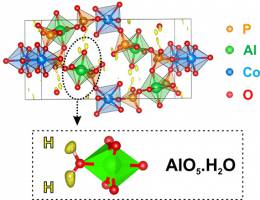
Diffraction-based analytical methods are widely used in laboratories, but they struggle to study samples that are smaller than a micrometer in size. Researchers from the Laboratoire de cristallographie et sciences des matériaux (CNRS/Ensicaen/Unicaen), the Laboratoire catalyse et spectrochimie (CNRS/Ensicaen/Unicaen) 1 , and the Academy of Sciences of the Czech Republic have nevertheless been successful in using electron diffraction to reveal the structure of nanocrystals 2 .
Life Sciences - Health - 11.01.2017
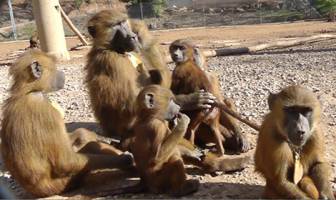
Baboons produce vocalizations comparable to vowels. This is what has been demonstrated by an international team coordinated by researchers from the Gipsa-Lab (CNRS/Grenoble INP/Grenoble Alpes University), the Laboratory of Cognitive Psychology (CNRS/AMU), and the Laboratory of Anatomy at the University of Montpellier, using acoustic analyses of vocalizations coupled with an anatomical study of the tongue muscles and the modeling of the acoustic potential of the vocal tract in monkeys.
Chemistry - History & Archeology - 09.01.2017

To paint quickly while creating exceptional texture and volume effects, J. M. W. Turner and other English artists of his generation relied on the development of innovative gels. All the rage in the 19th century—and still in use today—these compounds alter the properties of the oil paints they are combined with.
Health - Physics - 02.01.2017
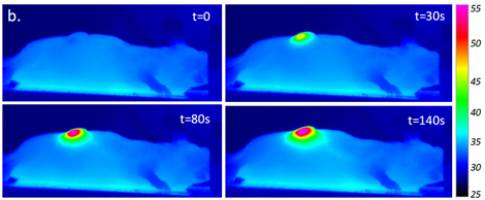
The mechanical resistance of tumors and collateral damage of standard treatments often hinder efforts to defeat cancers.
Chemistry - Life Sciences - 21.12.2016

Cells are the site of a multitude of chemical reactions, the precision of which is envied by scientists.
Chemistry - Physics - 21.12.2016

Hybrid organic-inorganic materials, which were developed approximately twenty years ago – notably by Gérard Férey, laureate of the CNRS 2010 Gold Medal, and his team – are known firstly for their extreme porosity. This remarkable property offers a diverse range of applications in the fields of energy, health, and sustainable development.
Life Sciences - Health - 21.12.2016

Pain serves as a valuable warning signal, but when it becomes chronic, pain should be considered as a real disease.
Life Sciences - Environment - 21.12.2016

It isn't an animal, a plant, or a fungus. The slime mold ( Physarum polycephalum ) is a strange, creeping, bloblike organism made up of one giant cell. Though it has no brain, it can learn from experience, as biologists at the Research Centre on Animal Cognition (CNRS, Université Toulouse III—Paul Sabatier) previously demonstrated.
Physics - 19.12.2016

Stretching time scales to explore extreme events in nature seemed impossible, yet this feat is now conceivable thanks to a team from the Institut FEMTO-ST (CNRS/UFC/UTBM/ENSMM), which used an innovative measurement technique enabling the capture of such events in real time. This technique, which is currently applied in the field of photonics, could help predict rogue wave events 1 on the ocean surface, along with other extreme natural phenomena.


Health - Today
Cortical thickness, schizophrenia, and causality in psychiatry: when the trace is mistaken for the cause
Cortical thickness, schizophrenia, and causality in psychiatry: when the trace is mistaken for the cause
Environment - Today
UCalgary expedition, with NASA, Canadian and European space agencies, sets out to better understand state of Arctic ice
UCalgary expedition, with NASA, Canadian and European space agencies, sets out to better understand state of Arctic ice
Social Sciences - Mar 24
Young people's wellbeing is improving in Greater Manchester, major survey finds
Young people's wellbeing is improving in Greater Manchester, major survey finds
Environment - Mar 24
Australia's environment is improving but climate change is 'accelerating' damage to ecosystems and wildlife
Australia's environment is improving but climate change is 'accelerating' damage to ecosystems and wildlife
Psychology - Mar 23
The grief myth: it doesn't come in stages or follow a checklist - like love, it endures
The grief myth: it doesn't come in stages or follow a checklist - like love, it endures
History & Archeology - Mar 23
The UV has played a part in the discovery of a 3,500-year-old loom that sheds light on key aspects of the Bronze Age textile revolution
The UV has played a part in the discovery of a 3,500-year-old loom that sheds light on key aspects of the Bronze Age textile revolution
Innovation - Mar 23
The University of Valencia launches ClioViz, an open digital platform for accessing cultural heritage data
The University of Valencia launches ClioViz, an open digital platform for accessing cultural heritage data
Social Sciences - Mar 23
Study links higher concentration of pokie machines to increase in family and domestic violence
Study links higher concentration of pokie machines to increase in family and domestic violence