


Event - Mar 17
CEA Leti to Showcase Integrated Expertise In Microelectronics Reliability at IRPS 2026
CEA Leti to Showcase Integrated Expertise In Microelectronics Reliability at IRPS 2026
Health - Mar 17
AI was supposed to ease doctors' workload - instead they spend hours correcting errors
AI was supposed to ease doctors' workload - instead they spend hours correcting errors



Pharmacology - Mar 17
International trial finds rapid diagnostic testing alone does not reduce antibiotic prescribing for respiratory infections
International trial finds rapid diagnostic testing alone does not reduce antibiotic prescribing for respiratory infections

Social Sciences - Mar 17
Social background shapes how hard children work, according to a study by UC3M
Social background shapes how hard children work, according to a study by UC3M
Innovation - Mar 17
With Robotics Innovation Center, CMU and Hazelwood Partners Sustain Community Collaborations
With Robotics Innovation Center, CMU and Hazelwood Partners Sustain Community Collaborations


news
Categories
Years
2008 | 2009 | 2010 | 2011 | 2012 | 2013 | 2014 | 2015 | 2016 | 2017 | 2018 | 2019 | 2020 | 2021 | 2022 | 2023 | 2024 | 2025 | 2026 |
2008 | 2009 | 2010 | 2011 | 2012 | 2013 | 2014 | 2015 | 2016 | 2017 | 2018 | 2019 | 2020 | 2021 | 2022 | 2023 | 2024 | 2025 | 2026 |
Last News
Results 741 - 760 of 1098.
Environment - 13.11.2025

TU Graz, TU Wien and the Environment Agency Austria have developed a method to determine microplastics in the inand outflow of sewage plants, and demonstrated their high elimination performance. The danger of microplastics for the environment and health has become increasingly recognised in recent years.
Chemistry - Environment - 13.11.2025
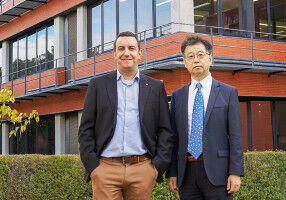
Scientists discover how to destroy Teflon and other persistent pollutants at room temperature An international team including a researcher from the University of Valencia has developed a system capable of degrading both Teflon (PTFE) and perfluoroalkyl substances (PFAS), known as "forever chemicals", without the need for high temperatures or complex chemical reagents.
Environment - Life Sciences - 13.11.2025
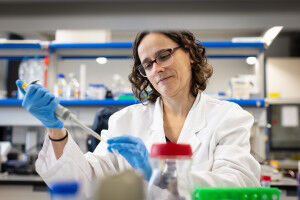
The transition from aquatic to terrestrial life has been one of the most significant evolutionary challenges. This decisive process in the evolution of life on Earth required a profound renewal of the genome. But what changes did genomes undergo to facilitate the transition to the terrestrial environment? Now, a study published in the journal Nature reconstructs the key genomic adaptations at different stages of the evolutionary transition to terrestrial ecosystems.
Health - Chemistry - 13.11.2025
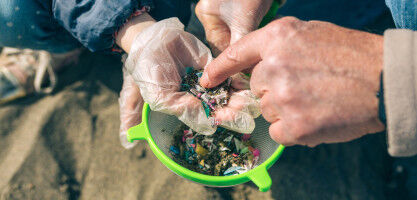
While microplastic pollution continues to advance, research into its possible effects on health remains hampered by technical hurdles: to date, there are no suitable methods for precisely identifying the particles in the body without destroying tissue.
Environment - Life Sciences - 13.11.2025

Many species benefit from the habitats that beavers create by building dams - and not just aquatic life. A new study by the WSL and Eawag research institutes shows that more bats hunt in beaver territories than outside of them. In the 19th century, beavers were extinct in large parts of Europe, with only a few thousand animals remaining.
Psychology - Life Sciences - 13.11.2025
Link between gut microbiome and autism not backed by science, researchers say
Posted on: 13 November 2025 There's no scientific evidence that the gut microbiome causes autism, a group of scientists argue in an opinion paper publishing today in international Cell Press journal Neuron. They say conclusions from past research that supported this hypothesis-including observational studies, mouse models of autism, and human clinical trials-are undermined by flawed assumptions, small sample sizes, and inappropriate statistical methods.
Physics - 13.11.2025
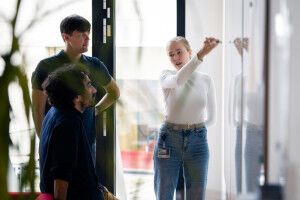
ISTA scientists solve complex quantum problems with the help of classical physics Quantum many-body scars are challenging our understanding of when and how quantum systems reach equilibrium. After recently demonstrating that they are more common than anticipated, researchers from the Serbyn group at the Institute of Science and Technology Austria (ISTA) have developed an algorithm to find them using classical equations of motion.
Microtechnics - Innovation - 12.11.2025
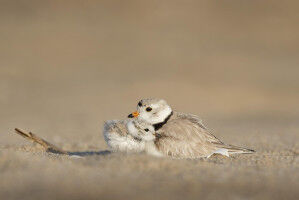
The first evidence that humans have the ability to sense objects without direct contact, a form of 'remote touch' that birds such as sandpipers have, has been presented in a new study from researchers at UCL and Queen Mary University of London. In terms of objects, human touch has typically been understood to be limited to physical touch, where we detect objects through contact with our skin.
Health - Computer Science - 12.11.2025

TU/e makes new medical AI model available worldwide Researchers at Eindhoven University of Technology (TU/e) have developed a medical AI model that helps doctors identify abnormalities in CT scans at an earlier stage, enabling faster diagnosis of cancer and other diseases. The model was trained on more than a quarter of a million CT scans.
Environment - 12.11.2025

Scientists have developed a new way to represent the world's cities in global climate and Earth system models (GCM & ESMs), offering a more accurate picture of how urban areas are being affected by - and contributing to - climate change.
Health - Life Sciences - 12.11.2025

As language models learn to interpret words in a sentence, protein Language Models learn how amino acids work together within a protein Konstantina Tzavella, who used artificial intelligence in her r
Environment - History & Archeology - 12.11.2025
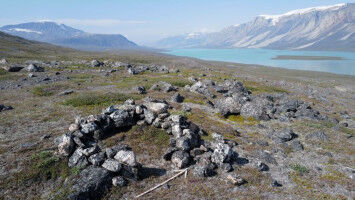
For thousands of years, the lives of many Inuit on Greenland were characterized by a regular rhythm: during the winter, they fished along the coast and hunted whales, seals and other marine mammals; in the summer, they moved inland and hunted caribou (reindeer).
Psychology - Life Sciences - 12.11.2025
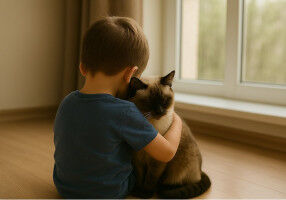
A research team from the INMA Project on childhood and environment - which includes the University of Valencia and the Fisabio Foundation of the Generalitat Valenciana among others - has analysed how pet ownership during the first years of life may be related to aspects of children's emotional and behavioural well-being.
Environment - Life Sciences - 12.11.2025
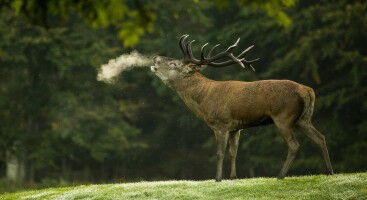
Rewilding A new nationwide survey from the University of Copenhagen shows that most Danes would like to see more large animals in the forests. Danes prefer forests with wild animals such as red deer and bison to traditional nature conservation with cattle and sheep. However, a significant minority are far from enthusiastic about nature with fences and large animals.
Life Sciences - Chemistry - 12.11.2025
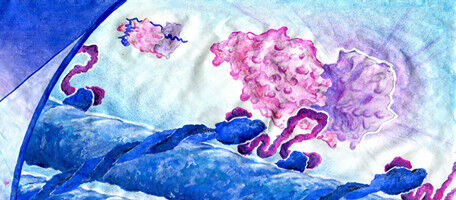
Scientists reveal how separase, a key enzyme in cell division, ensures the accurate separation of chromosomes. Cell division is a process of remarkable precision: during each cycle, the genetic material must be evenly distributed between the two daughter cells. To achieve this, duplicated chromosomes, known as sister chromatids, are temporarily linked by cohesin - a ring-shaped protein complex that holds them together until separation.
Life Sciences - 11.11.2025
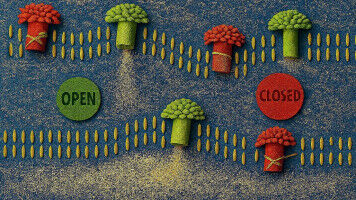
Researchers uncover how charge and structure control ion flow in biological nanopores, paving the way for new biosensors and ion-based computing. Pore-forming proteins are found throughout nature. In humans, they play key roles in immune defense, while in bacteria they often act as toxins that punch holes in cell membranes.
Chemistry - Physics - 11.11.2025
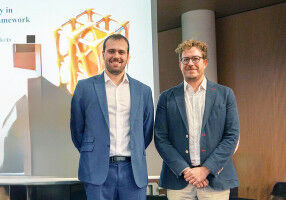
Researchers at the Institute of Molecular Science (ICMol) of the University of Valencia have developed a pioneering method to produce glasses from metal-organic frameworks (MOFs) in a simple and environmentally friendly way. This breakthrough opens new possibilities for the use of MOFs in fields such as electronics, clean energy and advanced technologies.
Environment - 11.11.2025
Over time, non-native plant species increasingly integrate into native food webs. Their region of origin or relatedness to native plants plays only a minor role. Far more decisive is how widely they have spread and how long they have been growing in Europe. The longer they have been established and the wider their distribution range, the more they are used by microherbivores such as leaf miners, gall midges and aphids - leading to similarly diverse interactions as with native plants.
Environment - 11.11.2025
Researchers from the University of Southern Denmark (SDU) and the University of Cambridge have, for the first time, mapped the total flow of plastic in the Nordic countries. The study shows that the Nordic region holds the world's largest stock of accumulated plastic per capita and that only around 5% is recycled domestically.
Media - 11.11.2025

New research from the University of Copenhagen points to a simple yet effective method for combating misinformation on social media: make it slightly harder to share content. Social media platforms like Facebook, Instagram, and X have made it incredibly easy to share content with friends and acquaintances through like and share buttons.


Event - Mar 17
CEA Leti to Showcase Integrated Expertise In Microelectronics Reliability at IRPS 2026
CEA Leti to Showcase Integrated Expertise In Microelectronics Reliability at IRPS 2026
Health - Mar 17
AI was supposed to ease doctors' workload - instead they spend hours correcting errors
AI was supposed to ease doctors' workload - instead they spend hours correcting errors
Pharmacology - Mar 17
International trial finds rapid diagnostic testing alone does not reduce antibiotic prescribing for respiratory infections
International trial finds rapid diagnostic testing alone does not reduce antibiotic prescribing for respiratory infections
Social Sciences - Mar 17
Social background shapes how hard children work, according to a study by UC3M
Social background shapes how hard children work, according to a study by UC3M
Innovation - Mar 17
With Robotics Innovation Center, CMU and Hazelwood Partners Sustain Community Collaborations
With Robotics Innovation Center, CMU and Hazelwood Partners Sustain Community Collaborations